Synth Legends: The Yamaha DX7 💠
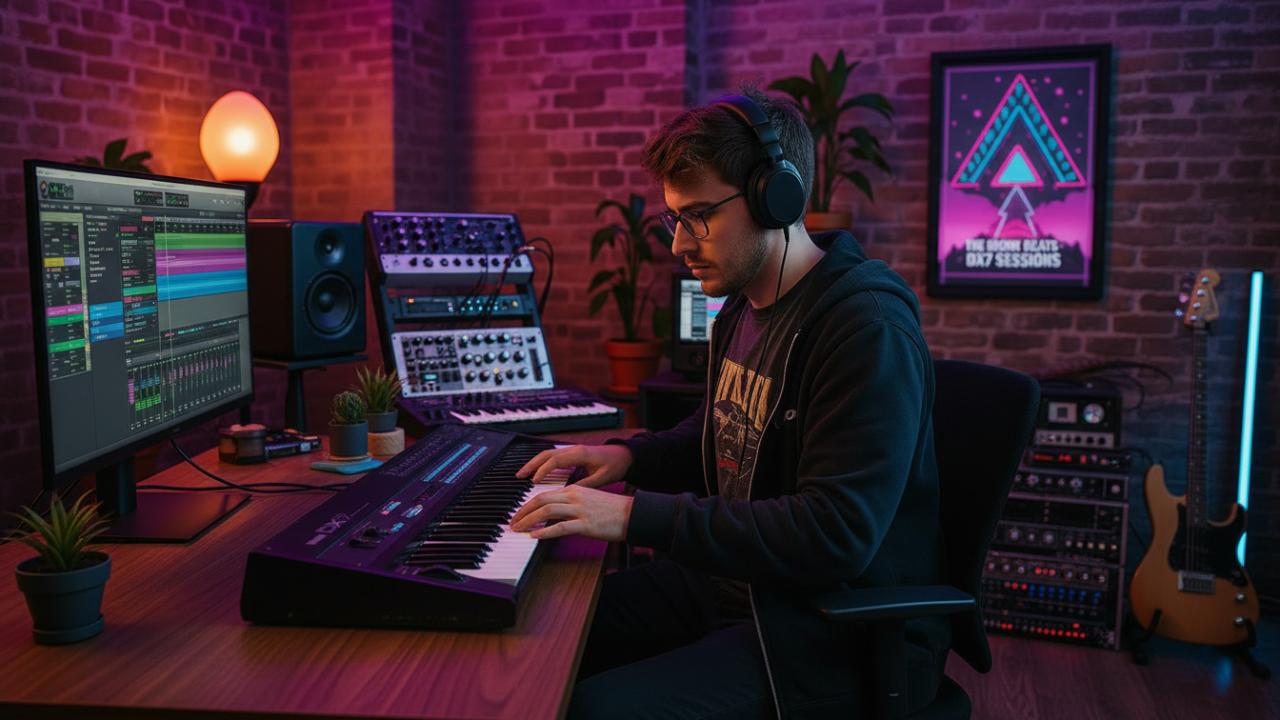
The Clean Break From Analog
In the mid-80s, music was drenched in warm analog pads, drifting oscillators, and chorus-soaked nostalgia.
Then the Yamaha DX7 arrived.
Sharp.
Precise.
Digital.
Cold in the most beautiful way.
It didn’t behave like analog.
It didn’t sound like analog.
It didn’t want to be analog.
It was a new language — a crystalline universe of electric pianos, glass bells, plucked harmonics, and metallic basses.
It gave producers a sound they’d never heard before:
clarity with character.
Quick Summary:
👉 Released in 1983, the Yamaha DX7 is a digital FM synthesizer whose crisp electric pianos, bells, and basses defined ’80s pop, R&B, electronic, and film music. It became one of the best-selling synths of all time.
⚙️ The History — The Day Digital Took the Wheel
Question: How did the DX7 change everything?
The DX7 was based on John Chowning’s FM synthesis research at Stanford — a breakthrough in using mathematical frequency ratios to create harmonically complex tones.
Yamaha licensed the tech and, in 1983, released a synth that:
-
cost less than many analog classics
-
stayed perfectly in tune
-
had incredible polyphony for the time
-
and shipped with presets that instantly became hits
It wasn’t just new technology.
It was the sound of the modern age.
🎯 Core Innovations
-
FM synthesis — bright, complex, harmonically rich digital tones.
-
32 algorithms — ways to patch operators for wildly different timbres.
-
Velocity sensitivity — expressive electric piano performance.
-
Memory presets — sounds ready to use instantly.
-
MIDI integration — a pioneer in standardized digital workflow.
“The DX7 didn’t enter the synth world — it redefined it.”
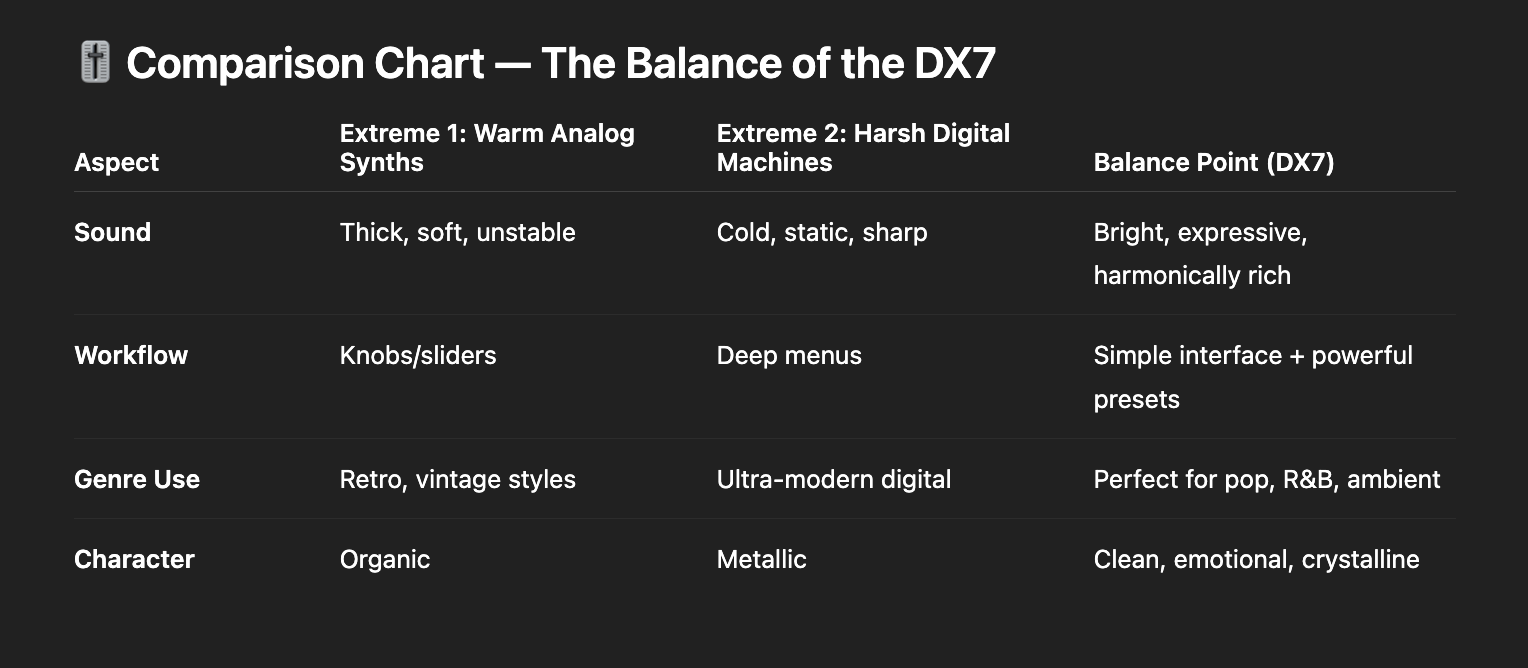
🧩 Balance Point
Between mathematical precision and musical emotion.
A digital instrument with expressive soul.
🔑 Key Takeaway
The DX7 made digital synthesis mainstream — and changed pop forever.
Synth Legends: The Roland Juno-106 🌈
🔊 The Originality — The Digital Crystal Sound
Question: Why does the DX7 sound so different from analog?
Because it wasn’t based on subtractive synthesis at all.
It added complexity instead of filtering it away.
FM tones feel like:
-
shimmering glass
-
struck metal
-
glowing bells
-
tense harmonics
-
plucked wires
-
crystalline pads
It was the first synth that sounded like nothing else on Earth.
🎯 Core Sound Traits
-
Electric pianos — especially the iconic E.Piano 1 preset.
-
Bells & chimes — shiny, airy, instantly nostalgic.
-
Punchy basses — bright, percussive, FM bite.
-
Metallic plucks — perfect for R&B and Japanese pop.
-
Percussive leads — cutting yet emotional.
“The DX7 sounded like the future — a clean break from the analog past.”
🧩 Balance Point
Between bright precision and dynamic expressiveness.
It could be cold or warm depending on the musician.
🔑 Key Takeaway
The DX7’s originality comes from its crystalline, expressive digital tone.
Synth Legends: The Moog Minimoog 🎛️
🌍 The Cultural Impact — The Presets That Took Over the World
The DX7 didn’t just appear in the ’80s.
It became the ’80s.
Its presets were used exactly as-is — and are still instantly recognizable today.
 ⭐️ Start by downloading all of my FREE Music Production Guides ⭐️ It took me years to learn this stuff!
🎤 ’80s Pop — The Golden Decade of FM
The entire world used the DX7.
Literally.
Key artists & songs
-
Toto – “Africa” (E. Piano & marimba-like tones)
-
Whitney Houston – “Saving All My Love for You”
-
A-ha – multiple hits
-
Phil Collins – “One More Night”
-
Brian Eno (DX7 programmer extraordinaire)
FM became the pop sound.
🎹 R&B & Soul — The Signature Electric Piano
No other keyboard was as dominant in R&B ballads.
Key artists
-
Janet Jackson
-
Babyface
-
Luther Vandross
-
Sade
-
Anita Baker
That smooth, glassy DX7 EP sound is the DNA of quiet-storm R&B.
🎛️ Electronic, Ambient & Experimental
Producers discovered that FM wasn’t just for pop — it could be celestial.
Key artists
-
Brian Eno (DX7 guru)
-
Vangelis
-
Aphex Twin (later FM explorations)
-
Boards of Canada (DX-style textures)
FM became a pathway to unusual tones and emotional ambient soundscapes.
Classic Drum Machines: The LinnDrum 🥁
🎬 Film & Game Music — The Digital Age Begins
FM shaped entire industries.
Examples
-
Early anime soundtracks
-
Video game consoles (Yamaha OPN FM chips)
-
1980s film scores
The DX7 sound became the sound of digital worlds.
🧩 Balance Point
Between mainstream pop and experimental art.
FM synthesis could do both — and everything in between.
🔑 Key Takeaway
The DX7 wasn’t just influential — it was ubiquitous.
🧠 FAQ
Q: When was the DX7 released?
A: 1983.
Q: Why was the DX7 so popular?
A: Its presets were instantly usable, expressive, and fit the sound of modern production.
Q: What is FM synthesis?
A: A technique that uses modulating frequencies to create bright, complex digital tones.
Q: Who used the DX7?
A: Toto, Whitney Houston, Brian Eno, Phil Collins, Janet Jackson, A-ha, and countless ’80s and ’90s artists.
 ⭐️ Download my Free Guide The Magic EQ Settings that work on EVERYTHING!
🔑 Why This Matters
The DX7 didn’t just influence music.
It rewrote the sonic vocabulary of an entire era.
It gave producers:
-
clarity
-
expressiveness
-
sophistication
-
digital emotion
-
and presets that became cultural landmarks
“The DX7 didn’t follow trends.
It created the sound of a decade.”

⭐️ Download my Free Magic Delay settings Guide ⭐️

⭐️ Download my Free Magic Reverb settings Guide ⭐️
#protools #daw #homestudio #recordingschool #recording #musicproduction
Also read:
How to Start Your Own Online Business Teaching Music

Hey, I'm Futch - Music Production Coach and Ableton Certified Trainer

Learn how to make your first song and beat in Ableton Live with my
FREE 90-minute Ableton Live course
I've been teaching audio engineering and music production for 35 years.⭐️
Check out my new online music production program: Music Production Ninja...