Synth Legends: The Roland Juno-106 🌈
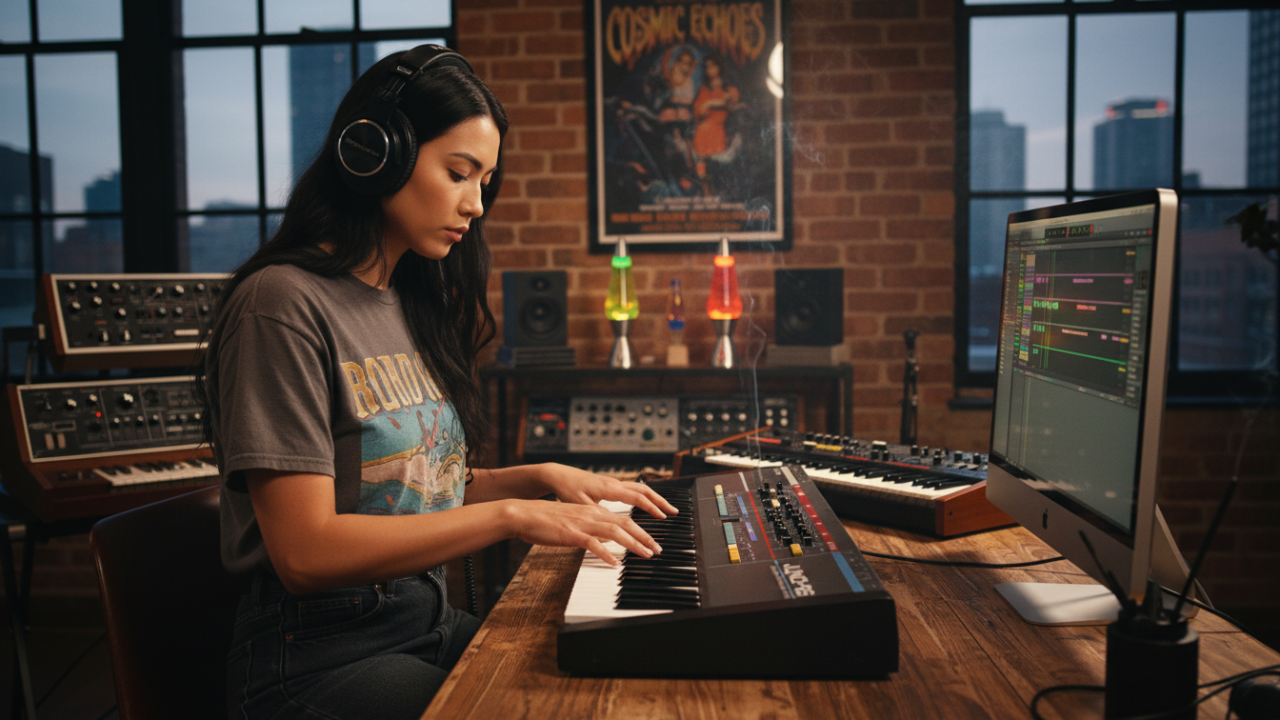
The Sound of Memory
Not every legendary synth is complex.
Not every classic is expensive.
Some machines become iconic because they make everyone sound good.
The Roland Juno-106 is that machine.
Warm pads.
Punchy bass.
Velvety leads.
A chorus that turns simple notes into cinematic nostalgia.
It didn’t try to overwhelm musicians with options.
It simply gave them a sound they’d fall in love with.
Quick Summary:
👉 Released in 1984, the Roland Juno-106 is a warm, easy-to-program analog polysynth with digitally controlled oscillators and a legendary stereo chorus. Its sound shaped ’80s pop, synthwave, house, techno, and modern electronic music.
The Softube Model 84 is a virtual instrument plugin that emulates the Roland Juno 106
⚙️ The History — Simple, Affordable, Unforgettable
Question: Why was the Juno-106 created?
Roland wanted to build a synth that was:
-
affordable
-
stable
-
easy to program
-
ideal for stage performers and studio producers
In 1984, they released the Juno-106, replacing the earlier Juno-60 and Juno-6 with:
-
MIDI
-
patch memory
-
digitally controlled analog oscillators
-
a smooth workflow that felt instantly playable
The 106 wasn’t meant to be a flagship.
It was meant to be a favorite.
🎯 Core Innovations
-
DCO — "Digitally Controlled Oscillator" = analog tone with rock-solid tuning.
-
MIDI — game-changing for early ’80s sequencing.
-
Patch memory — save your sounds instantly.
-
IR3109 filter — lush, resonant, unforgettable.
-
The chorus — the secret weapon of the entire synth.
“The Juno-106 didn’t compete with complex synths — it became the emotional one.”
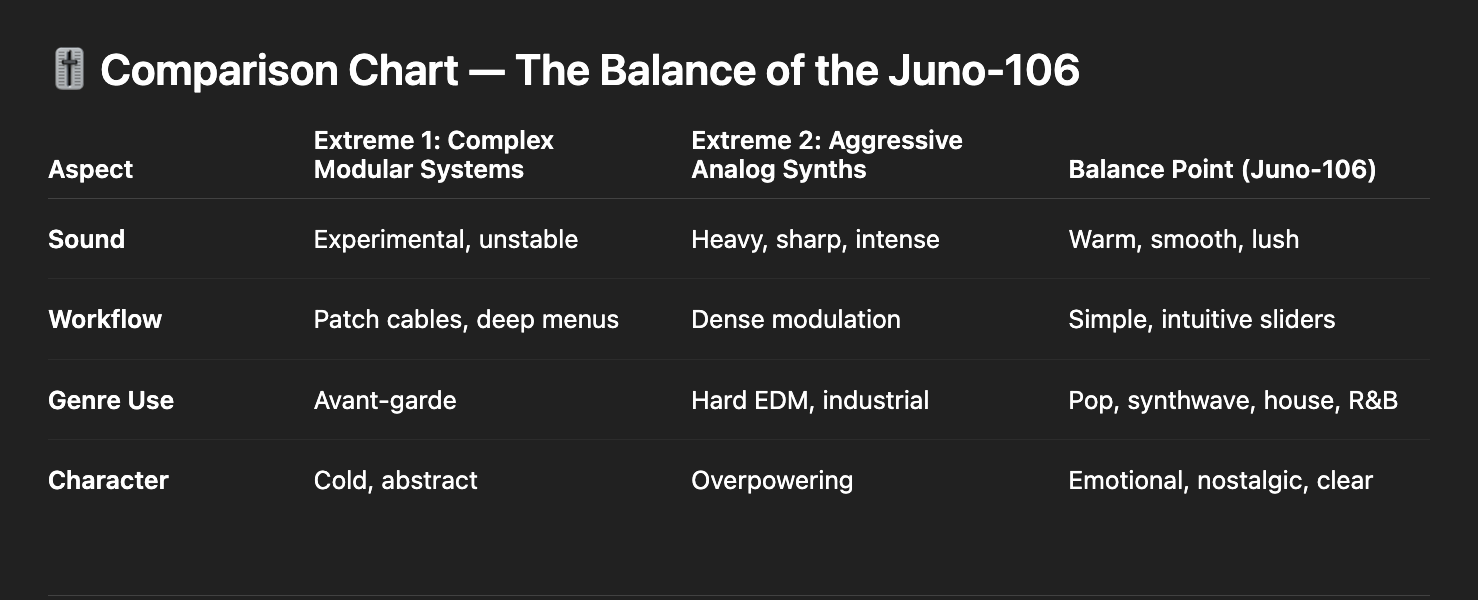
🧩 Balance Point
Between simplicity and warmth.
Between feature-light and sound-heavy.
🔑 Key Takeaway
The Juno-106 made analog synthesis accessible — and musical.
Synth Legends: The Moog Minimoog 🎛️
🔊 The Originality — The Warm Glow of Analog Simplicity
Question: Why does the Juno-106 sound so special?
Because it’s the perfect combination of:
-
warm analog oscillators
-
silky low-pass filtering
-
creamy stereo chorus
-
hands-on sliders
-
instant vibe
Its tone feels like sunlight through dust.
Soft.
Present.
Eternal.
🎯 Core Sound Traits
-
Ethereal pads — the classic “80s emotional soundtrack” tone.
-
Sub-heavy basses — round and powerful.
-
Simple leads — clean, warm, expressive.
-
Plucks & keys — perfect for pop, synthwave, R&B.
-
The Chorus — lush, shimmering, iconic.
“The Juno-106 is what happens when analog warmth meets emotional simplicity.”
🧩 Balance Point
Between character and clarity.
It’s warm without being muddy.
Bright without being sharp.
🔑 Key Takeaway
The Juno-106’s originality lives in its emotional tone.
9 Sound Design Fundamentals for Beginner Producers in 2025
 ⭐️ Start by downloading all of my FREE Music Production Guides ⭐️ It took me years to learn this stuff!
🌍 The Cultural Impact — The Sound of Dreamscapes
Few synthesizers crossed as many genres while keeping their identity intact.
The Juno-106 became a universal emotional tool.
🎤 ’80s Pop — The Decade Defined
The Juno-106 sound became the backdrop of ’80s radio.
Key artists
-
Eurythmics
-
Madonna
-
A-ha
-
Howard Jones
-
Pet Shop Boys
Its pads and keys shaped the sound of the era.
🌃 Synthwave — The Revival
When synthwave exploded, the Juno became its spiritual center.
Key artists
-
Kavinsky
-
FM-84
-
The Midnight
-
Timecop1983
The Juno chorus is the soundtrack of neon nostalgia.
Classic Drum Machines: The LinnDrum 🥁
🎛️ House & Techno — The Club Essential
Producers loved its stability and warmth.
Key artists
-
Mr. Fingers (Larry Heard)
-
Jeff Mills
-
Orbital
-
Underworld
Warm pads and punchy basslines defined early house and techno cuts.
🎹 Modern Electronic, R&B & Pop
The Juno-106 is a staple for modern production.
Used by
-
Tame Impala
-
Daft Punk
-
Flume
-
SOPHIE
-
Frank Ocean
-
Tycho
It works everywhere because it feels good everywhere.
Classic Drum Machines: The Oberheim DMX 🥁
🧩 Balance Point
Between retro vibe and modern usability.
Classic sound that still fits future-leaning production.
🔑 Key Takeaway
The Juno-106 is a time machine — every note feels like memory.
🧠 FAQ
Q: When was the Juno-106 released?
A: 1984.
Q: Why is the Juno-106 chorus famous?
A: It adds lush stereo width and warmth, instantly making patches feel emotional and cinematic.
Q: What genres use the Juno-106?
A: ’80s pop, synthwave, house, techno, R&B, ambient, film scoring, modern pop and electronic.
Q: Why do producers still love the Juno-106?
A: Its sound is warm, simple, mix-friendly, and inspiring with minimal tweaking.
 ⭐️ Download my Free Guide The Magic Compressor Settings that work on EVERYTHING!
🔑 Why This Matters
The Juno-106 isn’t legendary because it’s complex.
It’s legendary because it’s human.
It gave producers a way to create:
-
pads that breathe
-
bass that supports
-
leads that uplift
-
keys that shimmer
“The Juno-106 isn’t a synthesizer.
It’s a feeling.”

⭐️ Download my Free Magic Delay settings Guide ⭐️

⭐️ Download my Free Magic Reverb settings Guide ⭐️
#protools #daw #homestudio #recordingschool #recording #musicproduction
Also read:
How to Start Your Own Online Business Teaching Music

Hey, I'm Futch - Music Production Coach and Ableton Certified Trainer

Learn how to make your first song and beat in Ableton Live with my
FREE 90-minute Ableton Live course
I've been teaching audio engineering and music production for 35 years.⭐️
Check out my new online music production program: Music Production Ninja...