Top Drum Overhead Miking Techniques 🥁

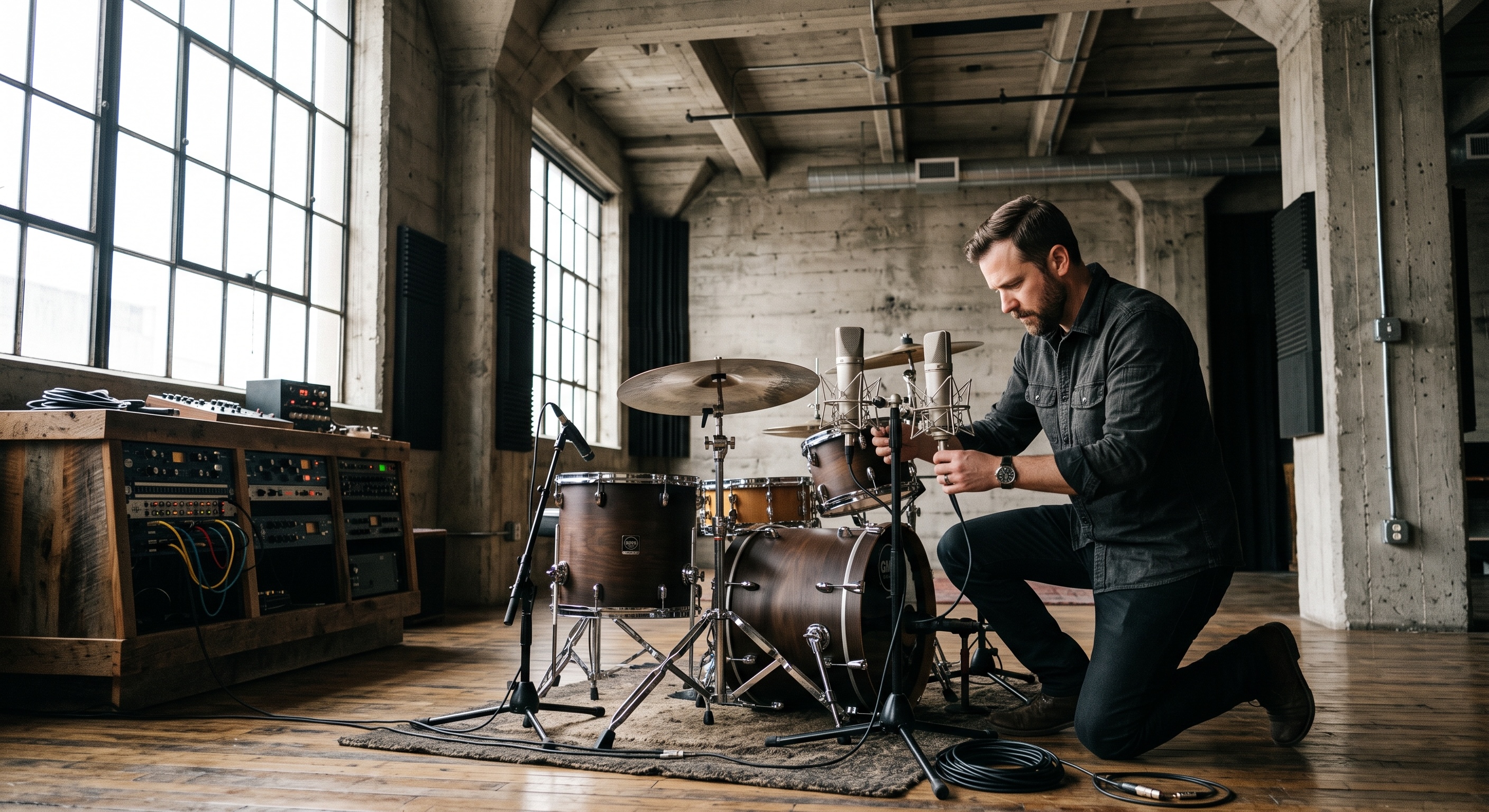
The Overheads Hear the Drum Kit
"If you want a great drum sound...
Start with the overheads."
Many beginner engineers think overhead microphones are for recording cymbals.
They're not.
They're for recording the drum kit.
The close microphones give you control.
The overheads give you perspective.
They capture how every drum relates to every other drum.
They create the stereo image.
They glue the kit together.
Without great overheads...
Even perfectly miked close drums can sound like individual instruments instead of one cohesive performance.
How to Tune Analog Drums & Drum Samples for Recording and Music Production 🥁
Quick Summary
👉 Drum overhead microphones capture the entire drum kit, not just the cymbals. The most common overhead techniques are XY, Spaced Pair (A/B), ORTF, Glyn Johns, Recorderman, Mid-Side (M/S), and Blumlein. Each produces a different balance of stereo width, phase coherence, room ambience, and punch. The best choice depends on the drummer, the room, and the musical genre.
🥁 Think of the Drum Kit as One Instrument
Imagine recording a piano.
You wouldn't put a microphone on every key.
You'd record the piano.
The same idea applies to drums.
Although modern recordings often use close mics on:
- Kick
- Snare
- Hi-hat
- Rack toms
- Floor tom
- Ride
The overheads capture the instrument as a whole.
Close mics create control.
Overheads create cohesion.
🎚️ The Two Jobs of Drum Microphones
Close Mics
Close microphones give you:
- Punch
- Isolation
- Compression control
- EQ flexibility
- Drum replacement
- Editing
They're your precision tools.
Overheads
Overheads provide:
- Stereo image
- Cymbal balance
- Kit perspective
- Room interaction
- Natural drum tone
They're what makes the drums feel like one performance instead of several separate recordings.
Explosive Rhythms: Mixing Drums Like a Pro With Your Home Studio DAW
1. 🎯 XY (Coincident Pair)
What It Is
Two microphones.
Capsules almost touching.
Typically positioned at a 90° angle.
Because both capsules occupy nearly the same point in space, XY produces excellent phase coherence and collapses to mono very cleanly.
Sound
- Focused
- Tight
- Punchy
- Excellent mono compatibility
- Narrower stereo image
Best Genres
- Pop
- Punk
- Live recordings
- Broadcast
- Television
- Smaller rooms
Whenever mono compatibility matters...
XY is hard to beat.
Classic Example
Nirvana – "Smells Like Teen Spirit"
The drum sound stays powerful and centered without feeling exaggeratedly wide.
(While the exact setup varied by engineer and session, the focused stereo perspective is a good reference for the kind of sound XY produces.)
2. 🌎 Spaced Pair (A/B)
What It Is
Two microphones placed several feet apart above the kit.
This is probably the most common modern overhead technique.
Sound
- Wide
- Open
- Spacious
- Big cymbals
- Lots of room
The tradeoff?
More potential phase problems.
Proper measurement and listening are essential.
Best Genres
- Rock
- Metal
- Modern Pop
- Worship
- Cinematic music
Classic Example
Foo Fighters – "Everlong"
Huge.
Wide.
Explosive.
The overheads help make the kit feel enormous.
3. 📐 ORTF
What It Is
ORTF places the microphones about 17 cm apart at roughly 110 degrees.
Think of it as the middle ground between:
XY...
and...
Spaced Pair.
Sound
- Natural
- Wide
- Balanced
- Realistic
- Excellent stereo localization
Many engineers consider ORTF one of the most "human" sounding stereo techniques.
Best Genres
- Folk
- Jazz
- Singer-songwriter
- Americana
- Acoustic music
Classic Example
Norah Jones – "Don't Know Why"
The drums feel natural.
They're part of the room.
Not artificially wide.
4. 🎸 Glyn Johns
What It Is
Perhaps the most famous drum miking technique ever invented.
Instead of using two symmetrical overheads...
One microphone sits above the snare.
The other sits beside the floor tom.
Both microphones are carefully measured so they're exactly the same distance from the snare.
Usually:
- Kick mic
- Snare mic
- Two overheads
That's it.
Sound
- Huge
- Open
- Natural
- Punchy
- Classic rock
This technique captures the drummer playing a kit...
Not individual drums.
Best Genres
- Classic Rock
- Blues
- Indie Rock
- Vintage recordings
Classic Example
Led Zeppelin – "When the Levee Breaks"
John Bonham's legendary drum sound embodies the natural, roomy philosophy that Glyn Johns championed, even though that iconic recording also relied heavily on the stairwell acoustics and distant room microphones.
5. 🥁 Recorderman
What It Is
Inspired by the Glyn Johns philosophy.
One microphone sits above the snare.
The second sits over the drummer's right shoulder.
Both are measured so the kick and snare are exactly the same distance from each microphone.
Sound
- Tight center
- Great punch
- Excellent phase
- Surprisingly big with only a few microphones
Best Genres
- Home studios
- Rock
- Worship
- Pop
- Smaller recording spaces
Classic Example
There isn't one famous "Recorderman record."
Instead...
It's become one of the internet's most popular techniques because it produces excellent results with minimal equipment.
 ⭐️ Download my Free Music Production Guides or take my free Ableton Live Course ⭐️
6. 🎙️ Mid-Side (M/S)
What It Is
One cardioid microphone points directly at the kit.
A figure-8 microphone captures the sides.
Inside your DAW, the side signal is decoded into stereo.
Sound
- Adjustable stereo width
- Excellent mono compatibility
- Focused center image
- Flexible during mixing
Best Genres
- Film scoring
- Jazz
- Orchestral
- Experimental music
Classic Example
Common in film scoring and broadcast recording, rather than associated with one famous pop recording.
7. 🎗️ Blumlein
What It Is
Two figure-8 microphones arranged as an XY pair.
Unlike standard XY...
Blumlein captures:
- Front
- Sides
- Rear reflections
It's one of the most immersive stereo techniques available.
Sound
- Three-dimensional
- Airy
- Deep
- Extremely realistic
Best Genres
- Jazz
- Classical
- Audiophile recordings
- Beautiful sounding rooms
Classic Example
Many audiophile jazz recordings use Blumlein techniques because they preserve the feeling of sitting in the room with the musicians.
🎵 Choosing the Right Technique for the Genre
Every genre tells a different story.
That changes how you mic the drums.
Rock
Think:
- Power
- Punch
- Width
Great choices:
- Spaced Pair
- Glyn Johns
Metal
Think:
- Precision
- Fast transients
- Editing flexibility
Great choices:
- Spaced Pair
- XY
Close mics usually carry much more of the final mix.
Jazz
Think:
- The drummer performing naturally
Great choices:
- ORTF
- Blumlein
- Mid-Side
The overheads often provide most of the drum sound, with minimal close-mic reinforcement.
Indie & Alternative
Think:
- Character
- Room
- Personality
Great choices:
- Glyn Johns
- Recorderman
Pop
Think:
- Balance
- Flexibility
- Translation
Great choices:
- XY
- Spaced Pair
- ORTF
🎧 Don't Ignore the Room
The overheads don't just hear the drums.
They hear:
- The ceiling
- The walls
- The reflections
- The room itself
A beautiful room rewards microphones placed higher.
A poor-sounding room often benefits from bringing the overheads closer to the kit to reduce unwanted ambience.
🧠 There Isn't One "Correct" Technique
Every drummer is different.
Every room is different.
Every song is different.
The "best" overhead technique is simply the one that serves the music.
Many engineers try several placements before committing to one.
The microphones haven't changed.
Only the perspective has.
🧠 FAQ
Q: Are overhead microphones just for cymbals?
A: No. Their primary job is to capture the entire drum kit as one instrument, including its stereo image and overall balance.
Q: What is the most common drum overhead technique?
A: Spaced Pair (A/B) is probably the most widely used in modern rock and pop, while XY remains a favorite when phase coherence is critical.
Q: What is the Glyn Johns technique?
A: A minimalist setup using two carefully measured overhead microphones, plus kick (and often snare), to create a natural, spacious drum sound.
Q: Which technique has the best stereo image?
A: Spaced Pair produces the widest image, while ORTF offers a more natural stereo perspective. XY provides the narrowest but most phase-coherent image.
Q: Should I always use close mics?
A: Not necessarily. Jazz, blues, and vintage recordings often rely heavily on the overheads. Rock, pop, and metal typically combine overheads with close mics for greater control.
🔑 Final Thought
Close microphones let you shape each drum.
Overheads let you hear the performance.
They capture the relationship between the kick and the snare.
The cymbals and the toms.
The drummer and the room.
Think of it like photography.
Close mics are the close-up portraits.
The overheads are the wide-angle shot that shows how everything fits together.
Close mics give you control.
Overheads give you cohesion.
Learn all of these techniques.
Experiment with them.
Because the best overhead placement isn't the one that's most popular...
It's the one that makes the drummer sound like they're sitting right in front of you.
 ⭐️ Download my Free Magic EQ settings Guide ⭐️

⭐️ Download my Free Magic Reverb settings Guide ⭐️
#protools #daw #homestudio #recordingschool #recording #musicproduction
Also read:
How to Start Your Own Online Business Teaching Music

Hey, I'm Futch - Music Production Coach and Ableton Certified Trainer

Learn how to make your first song and beat in Ableton Live with my
FREE 90-minute Ableton Live course
I've been teaching audio engineering and music production for 35 years.⭐️
Check out my new online music production program: Music Production Ninja...