Classic Drum Machines: The TR-808 🔊

The Boom That Became a Universe
The TR-808 wasn’t built to be famous.
It wasn’t built to be trendy.
It wasn’t even built to sound “real.”
It was built with transistors that were considered mistakes.
And those mistakes became magic.
At first, nobody wanted it.
Then everybody needed it.
Its low-end didn’t sound natural.
It sounded supernatural.
And for the first time, a drum machine didn’t imitate reality —
it created its own reality.
Quick Summary:
👉 Released in 1980, the Roland TR-808 used analog synthesis, booming bass, and distinctive tones to shape hip hop, electro, techno, trap, and pop — becoming one of the most influential instruments of all time.
⚙️ The History — The Machine Nobody Wanted
Question: How did the TR-808 begin?
Roland founder Ikutaro Kakehashi wanted an affordable drum machine for musicians — not studios.
Released in 1980, the 808 featured:
-
fully analog drum synthesis
-
16-step sequencing
-
an intuitive interface
-
unique booming bass
-
futuristic percussion sounds
The problem?
It didn’t sound like real drums.
And in 1980, no one wanted fake-sounding drums.
Roland discontinued it in 1983 after poor sales.
But in that short window, it fell into the hands of producers who heard something everyone else missed:
Possibility.
🎯 Core Innovations
-
Analog bass drum — the longest, deepest boom in drum-machine history.
-
Step sequencing — programmable rhythm for non-drummers.
-
Punchy snares & claps — now iconic samples.
-
Low cost after discontinuation — accessible to underground artists.
“The 808 wasn’t realistic. It was idealistic.”
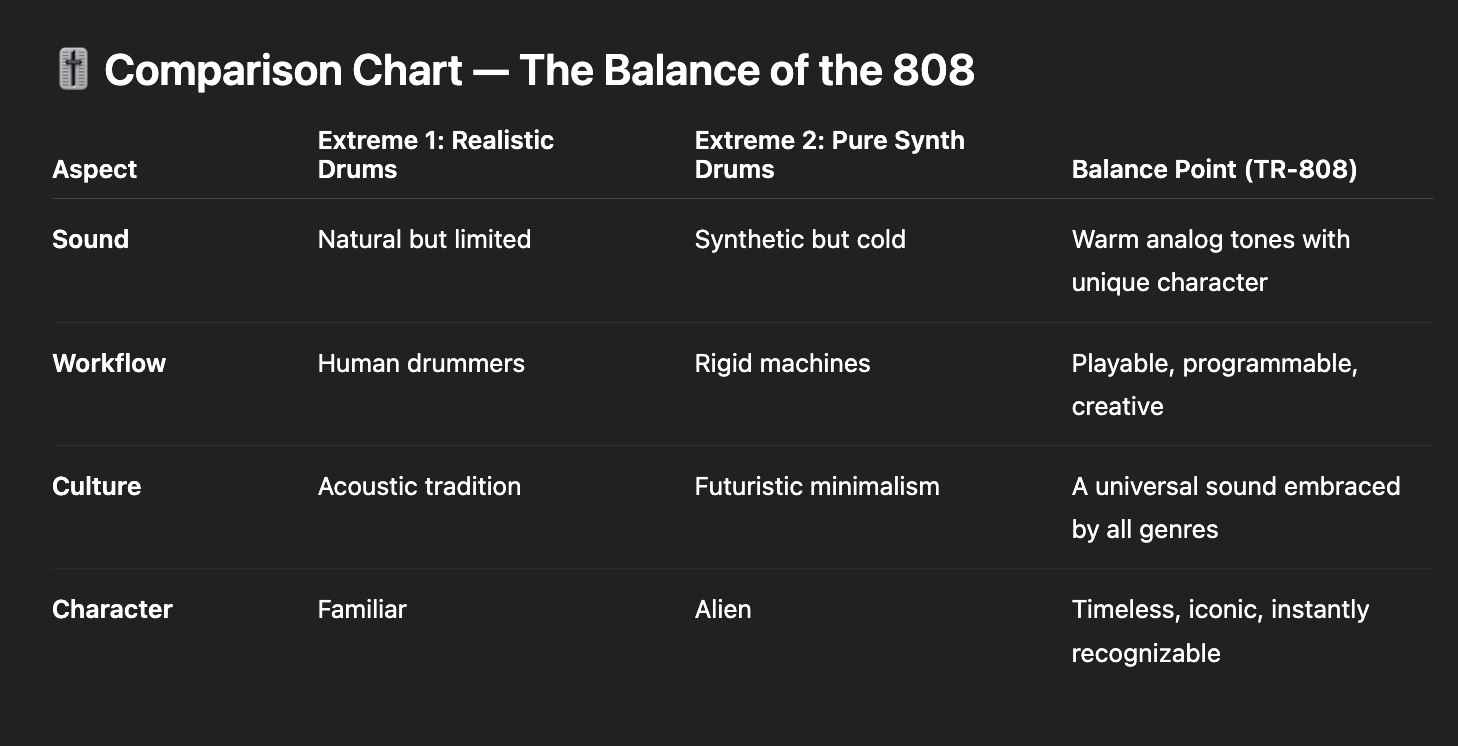
🧩 Balance Point
Between artificiality and emotion.
It didn’t mimic reality — it expanded it.
🔑 Key Takeaway
The 808 failed commercially but changed music forever.
Classic Drum Machines: The LinnDrum 🥁
🔊 The Originality — A Sound From a Parallel Future
Question: Why does the 808 still sound fresh?
Because it doesn’t exist anywhere else in nature.
Every sound — kick, snare, hi-hat, cowbell — came from analog circuitry, not samples.
The result was a sonic vocabulary that didn’t age.
It became its own instrument class.
🎯 Core Sound Traits
-
Bass drum that never ends — long decay, earth-shaking sub.
-
Snappy snare — bright, synthetic, unmistakable.
-
Closed hi-hats that tick with precision.
-
Open hi-hats that glide like air.
-
The cowbell — the most controversial sound in drum-machine history.
It all sounded wrong in 1980.
It sounds perfect now.
“The 808 didn’t age — music grew into it.”
🧩 Balance Point
Between simplicity and infinity.
A limited machine that created unlimited styles.
🔑 Key Takeaway
The 808’s originality lies in its refusal to imitate anything.
🌍 The Cultural Impact — From Electro to Trap to Pop
Few machines shapeshifted into as many genres as the TR-808.
It didn’t just fit genres — it created them.
 ⭐️ Download my Free Guide The Magic EQ Settings that work on EVERYTHING!
🎤 Hip Hop — The Revolution Begins
The 808 became hip hop’s foundation because it was cheap, loud, and expressive.
Key Artists & Songs
-
Afrika Bambaataa – “Planet Rock” (1982)
-
Run-D.M.C. – early demo work
-
Beastie Boys – “Hold It Now, Hit It”
-
Kanye West – 808s & Heartbreak
The 808 gave hip hop its weight — its physicality — its boom.
Afrika Bambaataa & The Soulsonic Force - Planet Rock (Official Music Video)
🎛️ Electronic — The Birth of Electro & Techno
Electronic pioneers embraced the 808’s robotic precision.
Key Artists & Songs
-
Cybotron – “Clear”
-
Juan Atkins & Detroit Techno architects
-
New Order (layered with DMX/other boxes)
-
Orbital, Aphex Twin, The Chemical Brothers
The 808 became the rhythmic backbone of early club culture.
🎹 Pop — From the Underground to the Billboard Charts
Once considered “too synthetic,” the 808 became the heartbeat of pop.
Key Artists & Songs
-
Whitney Houston – “I Wanna Dance With Somebody”
-
Phil Collins – “One More Night”
-
Madonna – early sessions
-
Beyoncé, Rihanna, Billie Eilish (modern 808-driven styles)
Its sound is now woven into mainstream production.
Classic Drum Machines: The SP-1200 🪨
🔊 Trap & Modern Production — The 808 Renaissance
The 808’s long-decay sub bass became the definition of trap music.
Key Artists
-
Lex Luger
-
Metro Boomin
-
Zaytoven
-
Mike Will Made-It
-
808 Mafia
The name 808 became a genre.
🧩 Balance Point
Between underground experimentation and mainstream dominance.
No other machine rules both worlds.
🔑 Key Takeaway
The 808 didn’t just influence genres — it became a universal language.
 ⭐️ Start by downloading all of my FREE Music Production Guides ⭐️ It took me years to learn this stuff!
🧠 FAQ
Q: When was the TR-808 released?
A: 1980, discontinued in 1983.
Q: What makes the 808’s kick unique?
A: Its analog circuitry allows extremely long, deep bass tones that shaped hip hop and trap.
Q: Which genres rely on the 808?
A: Hip hop, trap, electro, techno, pop, and modern electronic music.
Q: Who used the TR-808?
A: Afrika Bambaataa, Marvin Gaye, Kanye West, Beastie Boys, Pharrell, Metro Boomin, and countless others.
🔑 Why This Matters
The 808 isn’t retro.
It isn’t nostalgic.
It isn’t tied to a decade.
It’s a living instrument — one that continues to shape the future of music every day.
“The 808 didn’t follow trends.
It created them.”

⭐️ Download my Free Magic Delay settings Guide ⭐️

⭐️ Download my Free Magic Reverb settings Guide ⭐️
#protools #daw #homestudio #recordingschool #recording #musicproduction
Also read:
How to Start Your Own Online Business Teaching Music
Hey, I'm Futch - Music Production Coach and Ableton Certified Trainer
Learn how to make your first song and beat in Ableton Live with my
FREE 90-minute Ableton Live course
I've been teaching audio engineering and music production for 35 years.⭐️
Check out my new online music production program: Music Production Ninja...