Pythagorean Geometry in Music Production: Rhythm, Melody & Harmony 🔺

The Hidden Geometry Behind All Music
Long before plugins, DAWs, and waveforms, the Pythagorean school claimed something radical:
Number is the invisible structure behind all musical experience — and behind nature itself.
To them, music wasn’t just sound.
It was geometry made audible.
And from that worldview came three timeless teachings — one for rhythm, one for melody, one for harmony — each built on pure ratio.
Quick Summary
👉 Pythagoreans believed rhythm, melody, and harmony all reflect numerical ratios: rhythm divides time, melody moves through ratios, and harmony reveals the pure proportions that shape nature itself.
🎚️ 1. Rhythm — Numbers in Time
Historical Background
Pythagoreans didn’t leave detailed rhythm treatises, but later writers describe rhythm as ordered movement created by numerical proportion — the time-based equivalent of interval ratios.
Pythagorean Teaching
-
Rhythm = ratios of duration.
Long/short, fast/slow, 2:1, 3:2 — the same math behind intervals applies to beats. -
Rhythm “binds motion.”
It shapes raw time into ordered feeling. -
Good rhythm = moral order.
They believed rhythmic balance shapes emotional and ethical balance.
Modern Interpretation
👉 Rhythm is the art of dividing time into meaningful proportions.
Balanced ratios create stable grooves; irregular ratios create tension.
In production terms:
-
swing = intentional ratio shift
-
quantization = numerical alignment
-
groove = ratio-based feel
How Does It Feel? Shuffle, Groove, and Swing 🎵
🎚️ 2. Melody — Numbers in Motion
Historical Background
For Pythagoreans, melody wasn’t random motion — it was the path between ratio-based pitches.
Every step was a geometric move.
Pythagorean Teaching
-
Melody = walking through numeric intervals.
It’s a journey through pure fifths, octaves, tones, and semitones. -
Melody reveals character.
Modes carried ethos because their interval ratios differed. -
Melody should reflect natural order.
Simpler intervals = clearer emotional expression.
Modern Interpretation
👉 Melody is “ratio in motion,” shaping the emotional arc of a track.
In production terms:
-
scale choice sets emotional identity
-
interval jumps change tension
-
melodic contour = psychological geometry
Adding Rhythm That Flows With Your Melody and Chords 🥁
 ⭐️ Download my Free Guide The Magic Compressor Settings that work on EVERYTHING!
🎚️ 3. Harmony — Numbers Made Audible
Historical Background
This is where the Pythagoreans are strongest.
They discovered that consonant intervals are built from simple, whole-number ratios:
-
Octave → 2:1
-
Fifth → 3:2
-
Fourth → 4:3
They believed these same ratios governed nature, the planets, and the human soul.
Pythagorean Teaching
-
Harmony = the fitting-together of opposites using number.
-
Harmony is the blueprint of the cosmos.
-
Internal harmony = health.
-
Hearing harmony = hearing number.
Modern Interpretation
👉 Harmony is the audible expression of simple ratios that create stability and emotional resolution.
In production terms:
-
the fifth = stability
-
the minor third = sorrow
-
the major triad = geometric clarity
-
chord progressions = ratio architecture
Circle of Fifths vs. Camelot Wheel - What's the Difference?

One Unified Idea
All three reveal different faces of the same truth:
Music shows the mathematical skeleton of reality.
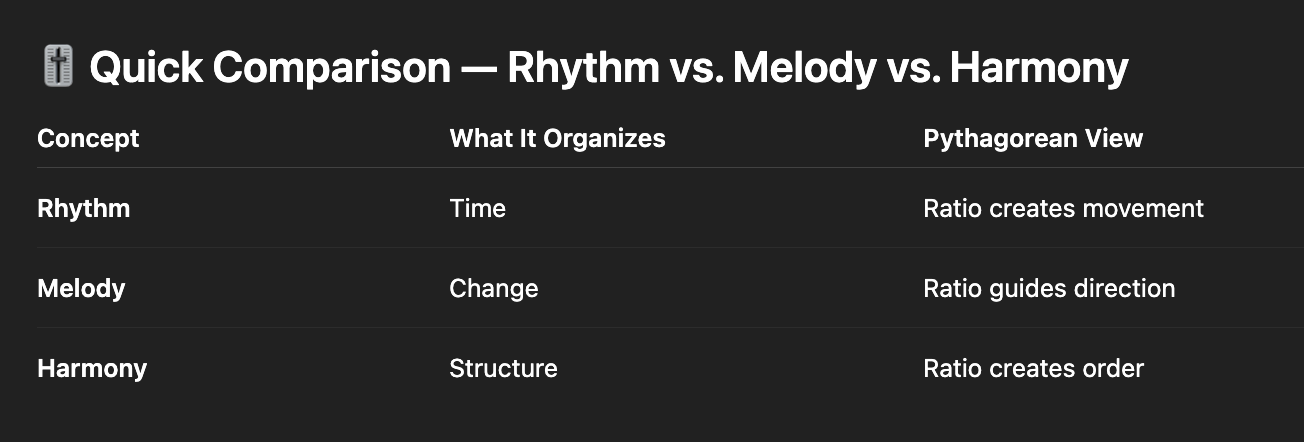
Rhythm orders movement.
Melody orders change.
Harmony orders being.
And production — from quantization to scale choice to chord structure — is still built on these ancient geometric principles.
🧠 FAQ
Q: Why were Pythagoreans obsessed with number?
A: They believed number was the underlying structure of nature, and music made that structure audible.
Q: Are these ratios still relevant in modern production?
A: Absolutely — rhythm grids, scales, tuning, intervals, and quantization all come from ratio-based thinking.
Q: Does Pythagorean tuning equal modern tuning?
A: Not exactly. But the foundational ratios (octave, fifth, fourth) remain universal.
 ⭐️ Start by downloading all of my FREE Music Production Guides ⭐️ It took me years to learn this stuff!
🔑 Why This Matters
Pythagorean geometry isn’t abstract mysticism — it’s the foundation of modern music.
Producers still work with:
-
divided time (rhythm)
-
stepped intervals (melody)
-
stacked ratios (harmony)
Everything you do in a DAW — from setting tempo to building progressions — is quietly guided by this ancient mathematical worldview.
Pythagorean geometry reminds us that music isn’t random — it’s ratio.
And ratio is the bridge between sound and the structure of the universe.

⭐️ Download my Free Magic Delay settings Guide ⭐️

⭐️ Download my Free Magic Reverb settings Guide ⭐️
#protools #daw #homestudio #recordingschool #recording #musicproduction
Also read:
How to Start Your Own Online Business Teaching Music

Hey, I'm Futch - Music Production Coach and Ableton Certified Trainer

Learn how to make your first song and beat in Ableton Live with my
FREE 90-minute Ableton Live course
I've been teaching audio engineering and music production for 35 years.⭐️
Check out my new online music production program: Music Production Ninja...