How Do I Get My Bass & Kick To Work Together in a Mix?🎚️

The Most Common Low-End Problem
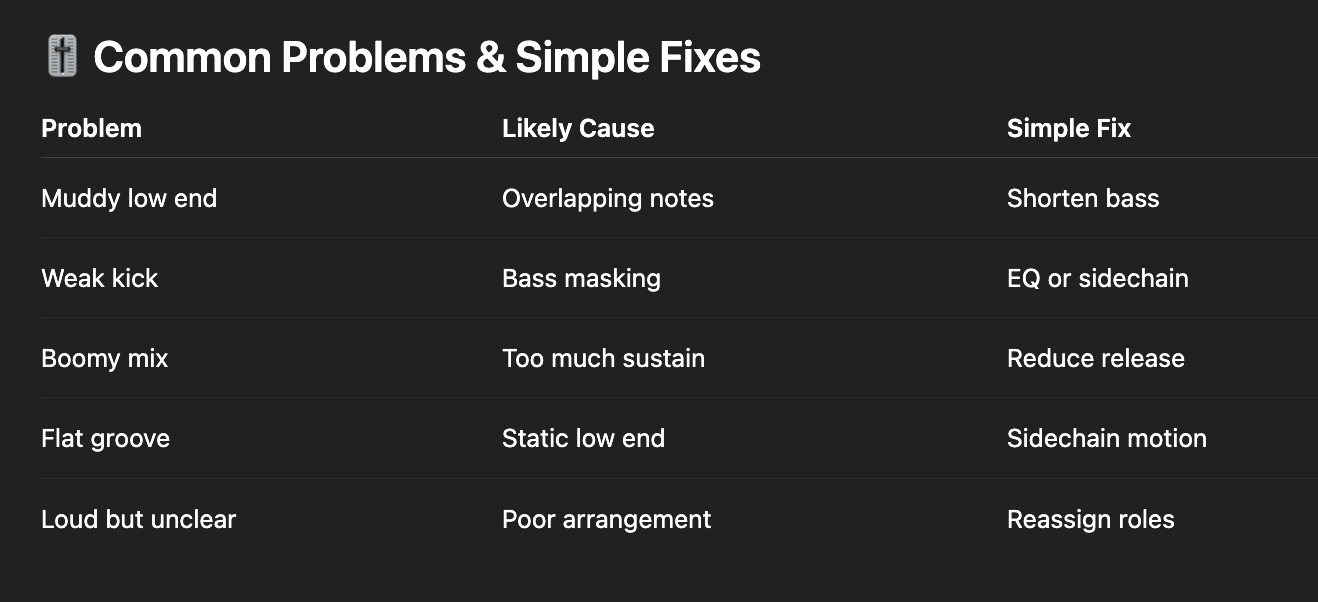
If your mix feels muddy, weak, or unfocused, there’s a good chance the problem lives in the low end.
Specifically:
the kick and the bass are fighting.
This isn’t a plugin problem.
It’s not a loudness problem.
It’s a relationship problem.
When kick and bass work together, the mix feels powerful and clear.
When they don’t, nothing else can save it.
Quick Summary
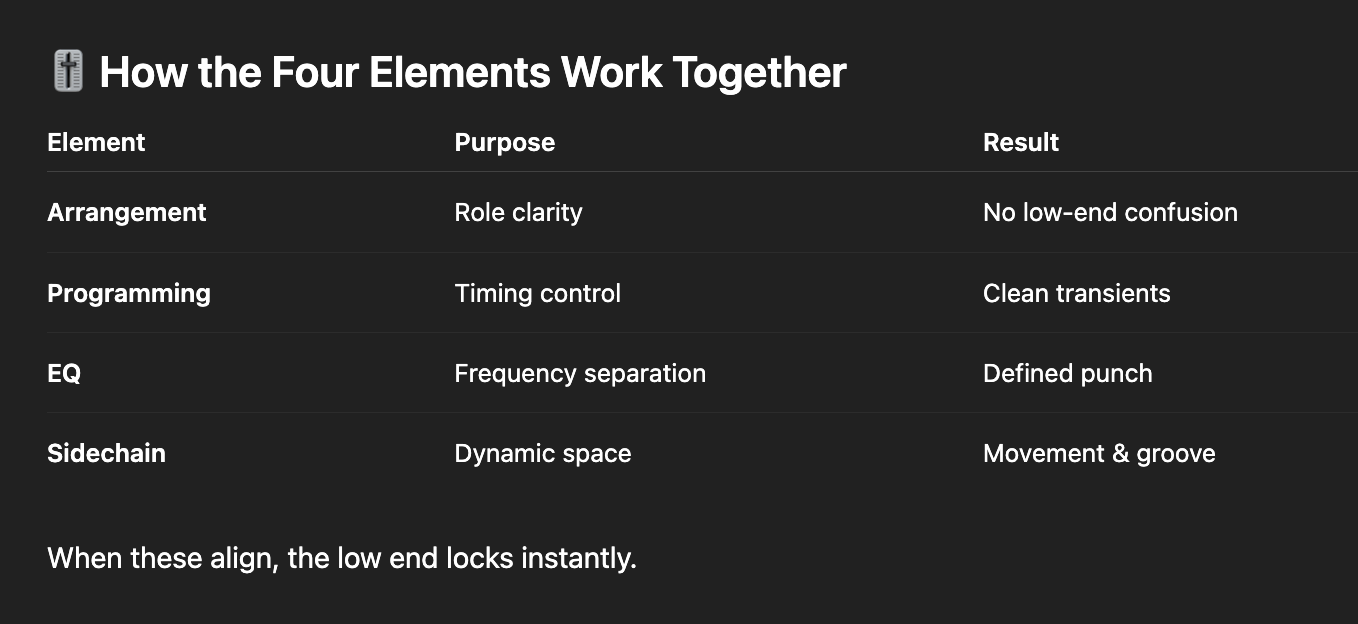
👉 Kick and bass work together when they are separated by arrangement, programmed with intention, shaped by EQ, and coordinated with sidechain compression.
🎚️ 1. Arrangement — Decide Who Leads
The most important decision happens before EQ or compression.
Ask one simple question:
Who is the boss of the low end — the kick or the bass?
You can’t have both dominating the same moment.
Common approaches
-
Kick leads, bass supports (EDM, pop, dance)
-
Bass leads, kick supports (hip-hop, R&B, funk)
-
Alternating roles by section
Practical move
If both hit hard at the same time, remove one — even briefly.
Arrangement fixes what plugins can’t.
Explosive Rhythms: Mixing Drums Like a Pro With Your Home Studio DAW
🎚️ 2. Programming — Don’t Stack Transients
Even perfectly EQ’d sounds will clash if they’re triggered at the same time.
Look at:
-
note length
-
rhythmic placement
-
sustain
-
release times
Simple fixes
-
shorten bass notes so the kick punches first
-
delay the bass slightly after the kick
-
remove bass notes where the kick hits
-
simplify one part
Practical move
Zoom in on the waveform.
If transients stack, energy collapses.
 ⭐️ Start by downloading all of my FREE Music Production Guides ⭐️ It took me years to learn this stuff!
🎚️ 3. EQ — Give Each One a Home
EQ is about separation, not boosting everything.
Decide where each element lives.
Typical starting points
-
Kick fundamental: ~50–80 Hz
-
Bass fundamental: ~80–120 Hz (or vice versa)
Practical EQ strategy
-
boost the kick where the bass is quieter
-
cut the bass slightly where the kick hits hardest
-
high-pass what doesn’t need sub energy
-
clean low-mid buildup (200–400 Hz)
Small EQ moves here change the entire mix.
Balance in Mixing: Subtractive vs. Additive EQ ⚖️
🎚️ 4. Sidechain Compression — Create Motion
Sidechain compression isn’t a crutch — it’s coordination.
By triggering a compressor on the bass using the kick, you:
-
create space instantly
-
preserve punch
-
add groove and movement
How to use it musically
-
fast attack
-
quick release
-
subtle gain reduction (1–4 dB)
The bass shouldn’t disappear — it should breathe.
Sidechain isn’t about ducking — it’s about cooperation.
Compressor vs Limiter: What's The Difference?
 ⭐️ Download my Free Guide The Magic EQ Settings that work on EVERYTHING!
🧠 FAQ
Q: Should I always sidechain bass to kick?
A: No — only when timing and EQ alone aren’t enough.
Q: Why does my low end sound loud but weak?
A: Because kick and bass are masking each other.
Q: Can EQ alone fix this?
A: Rarely. Arrangement and timing matter more.
Q: What should I fix first?
A: Arrangement — always start there.
🔑 Why This Matters
The low end is the foundation of your mix.
If it’s unclear, everything feels unstable.
Great mixes don’t have more bass — they have clearer bass.
When kick and bass stop competing and start cooperating, the entire mix opens up — louder, cleaner, and more confident.

⭐️ Download my Free Magic Delay settings Guide ⭐️

⭐️ Download my Free Magic Reverb settings Guide ⭐️
#protools #daw #homestudio #recordingschool #recording #musicproduction
Also read:
How to Start Your Own Online Business Teaching Music

Hey, I'm Futch - Music Production Coach and Ableton Certified Trainer

Learn how to make your first song and beat in Ableton Live with my
FREE 90-minute Ableton Live course
I've been teaching audio engineering and music production for 35 years.⭐️
Check out my new online music production program: Music Production Ninja...